

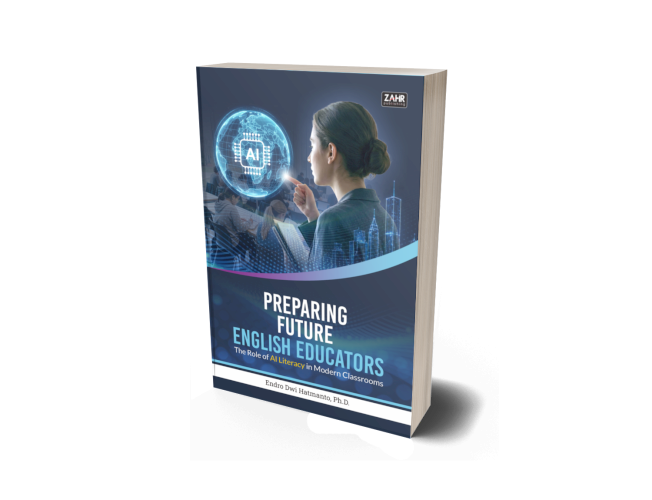
Preparing Future English Educators: The Role of AI Literacy in Modern Classrooms
| Penulis | : | Endro Dwi Hatmanto, Ph.D. |
| Ukuran | : | 15.5 x 23 cm |
| Tebal | : | xiv + 232 hlm. |
| ISBN | : | 978-623-466-866-7 |
| Cover | : | Soft cover |
| Berat | : | 350 gram |
Preparing Future English Educators: The Role of AI Literacy in Modern Classrooms is a reference book that responds to one of the most urgent shifts in contemporary English language education: the growing presence of artificial intelligence in teaching, learning, assessment, and communication. As AI tools increasingly shape how teachers design lessons, provide feedback, develop materials, and support students’ language learning, future English educators need more than general digital competence. They need AI literacy: the ability to understand, use, evaluate, and integrate AI critically, ethically, and pedagogically.
This book offers a comprehensive and human-centered exploration of AI literacy for pre-service English teachers, teacher educators, researchers, and curriculum developers. It begins by introducing the foundations of AI in education, clarifying key concepts, types of AI tools, and the relationship between AI literacy, digital literacy, and media literacy. It then examines the theoretical and pedagogical foundations of AI-supported English teaching, emphasizing that AI should function as a support tool rather than a replacement for teachers.
Across its chapters, the book discusses how AI literacy applies to core areas of English language teaching, including listening, speaking, reading, writing, vocabulary, grammar, and pronunciation. It also provides practical guidance for preparing pre-service teachers to select AI tools, design AI-integrated lessons, develop materials, conduct microteaching, and reflect on classroom practice. At the same time, the book gives serious attention to ethical issues such as data privacy, bias, inclusion, academic integrity, authorship, and responsible AI use.
A distinctive strength of the book is its balanced perspective. It recognizes AI’s potential to personalize learning, support feedback, increase efficiency, and enhance student engagement, while also warning against overdependence, misinformation, bias, and the loss of human judgment in education. Through case studies, reflective discussions, and practical implications, the book argues that the future of English teacher education should not be driven by technological inevitability, but by deliberate, critical, and ethical professional choice.
Ultimately, this book affirms that English teachers remain central in AI-mediated classrooms. Their role is not diminished by technology; rather, it becomes more important. Future English educators must be prepared to guide students in using AI responsibly while preserving the human values at the heart of language education: communication, creativity, identity, agency, culture, and meaning.
Stok Kosong
Preparing Future English Educators: The Role of AI Literacy in Modern Classrooms
| Penulis | : | Endro Dwi Hatmanto, Ph.D. |
| Ukuran | : | 15.5 x 23 cm |
| Tebal | : | xiv + 232 hlm. |
| ISBN | : | 978-623-466-866-7 |
| Cover | : | Soft cover |
| Berat | : | 350 gram |
Preparing Future English Educators: The Role of AI Literacy in Modern Classrooms is a reference book that responds to one of the most urgent shifts in contemporary English language education: the growing presence of artificial intelligence in teaching, learning, assessment, and communication. As AI tools increasingly shape how teachers design lessons, provide feedback, develop materials, and support students’ language learning, future English educators need more than general digital competence. They need AI literacy: the ability to understand, use, evaluate, and integrate AI critically, ethically, and pedagogically.
This book offers a comprehensive and human-centered exploration of AI literacy for pre-service English teachers, teacher educators, researchers, and curriculum developers. It begins by introducing the foundations of AI in education, clarifying key concepts, types of AI tools, and the relationship between AI literacy, digital literacy, and media literacy. It then examines the theoretical and pedagogical foundations of AI-supported English teaching, emphasizing that AI should function as a support tool rather than a replacement for teachers.
Across its chapters, the book discusses how AI literacy applies to core areas of English language teaching, including listening, speaking, reading, writing, vocabulary, grammar, and pronunciation. It also provides practical guidance for preparing pre-service teachers to select AI tools, design AI-integrated lessons, develop materials, conduct microteaching, and reflect on classroom practice. At the same time, the book gives serious attention to ethical issues such as data privacy, bias, inclusion, academic integrity, authorship, and responsible AI use.
A distinctive strength of the book is its balanced perspective. It recognizes AI’s potential to personalize learning, support feedback, increase efficiency, and enhance student engagement, while also warning against overdependence, misinformation, bias, and the loss of human judgment in education. Through case studies, reflective discussions, and practical implications, the book argues that the future of English teacher education should not be driven by technological inevitability, but by deliberate, critical, and ethical professional choice.
Ultimately, this book affirms that English teachers remain central in AI-mediated classrooms. Their role is not diminished by technology; rather, it becomes more important. Future English educators must be prepared to guide students in using AI responsibly while preserving the human values at the heart of language education: communication, creativity, identity, agency, culture, and meaning.
Stok Kosong


